

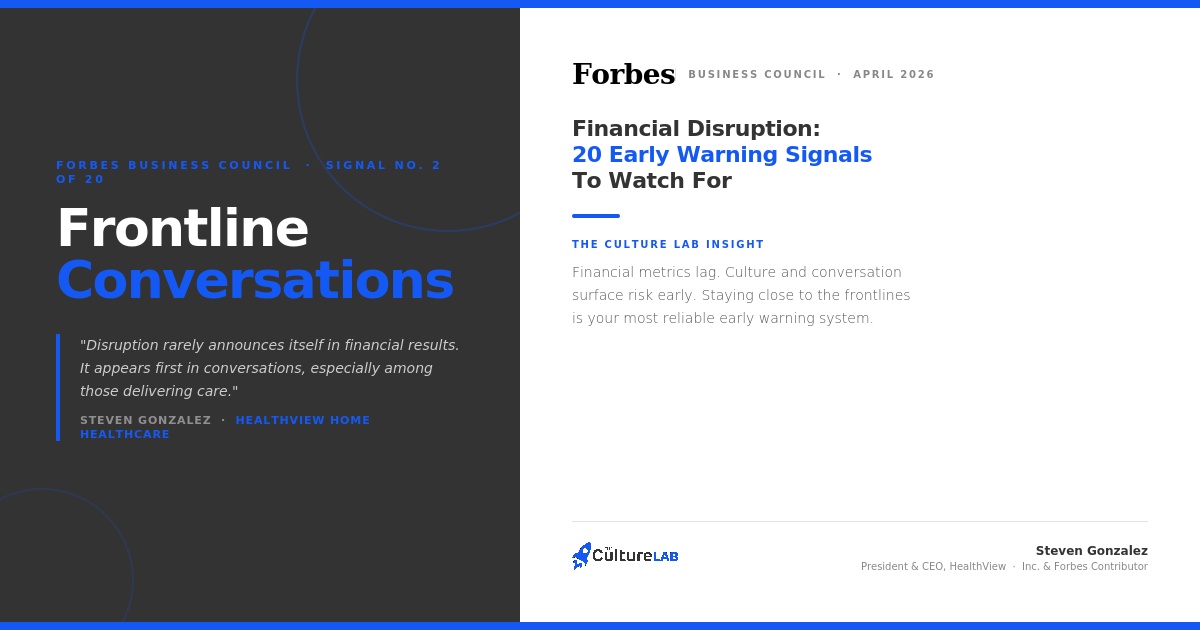

Financial Disruption: 20 Early Warning Signals To Watch For
A Forbes Business Council expert panel — featuring Steven Gonzalez, President and CEO of HealthView Home Healthcare Services.
Forbes Business Council brings together the most influential voices in business to share their expertise on the challenges leaders face today. In this expert panel piece, 20 contributors were asked: what are the early warning signals of financial disruption that leaders should be watching for?
Steven Gonzalez, President and CEO of HealthView Home Healthcare Services and founder of The Culture Lab, was featured as contributor number two in the panel with his insight on frontline conversations as one of the most reliable early indicators of financial stress.
Most financial crises do not announce themselves in spreadsheets. They announce themselves in the hallways, in shift handoffs, in the conversations that never make it to the executive team. The organizations that see disruption coming are the ones that have built systems to hear those signals early.
Culture Surfaces Risk Before the Dashboard Does
The insight behind Signal No. 2 is one that runs through the core of everything The Culture Lab is built on: financial metrics are lagging indicators. By the time disruption shows up in your revenue cycle, your margins, or your census numbers, the signal has already been present in your organization for weeks or months in a form that is much harder to quantify but much easier to feel.
In healthcare specifically, the people closest to the patient are the first to know when something is wrong. Field staff sense when scheduling is breaking down before the overtime numbers show it. Nurses notice when care coordination is slipping before readmission rates reflect it. Clinical supervisors feel the pressure of understaffing before HR reports the vacancy rate. These conversations are intelligence. The question is whether your organization has built the conditions under which that intelligence actually reaches leadership.
Psychological safety is not a culture initiative. It is a financial risk management tool. When staff feel safe enough to surface bad news early, organizations gain response time. When they do not, leadership finds out at the worst possible moment with the least possible runway to respond. The organizations that navigate financial volatility best are not always the ones with the best financial modeling. They are often the ones with the most honest internal communication.
This is why The Culture Lab exists. Culture is not separate from financial performance. In most service organizations, and especially in healthcare, culture is the leading indicator of financial performance. The conversation on the floor today is the P&L of next quarter.

