Epistemic status: High confidence on the Patagonia history; every number traces to contemporaneous reporting, the company’s own documents, or Chouinard’s book, in the references. Medium confidence on the transfer to post-acute care, because that is my industry, which means it is also where my bias lives. The prediction near the end goes on the ledger and gets scored like the others.
01Three Lessons, Then a Book
Last October I published an article in Inc. called 3 Leadership Lessons From Surfing. I compared leading through change to standing on a board in the ocean. Timing matters. Balance is everything. Respect the ocean. I meant every word and I still do.
And for the record, I have actually done it. There is a photo of me, posted where anyone can find it, up and riding, knees bent, arms out, face locked in the kind of concentration usually reserved for surgery, on a wave I will generously call waist high. I love that photo. I am also honest about what it shows. The board was a soft-top, the wave was doing most of the work, and I wrote my article as a man who has stood up a few times, not a man who built a life on the water.


Then I read the book by the man who did.
Yvon Chouinard built Patagonia on a rule he eventually named the company handbook after: when the surf comes up, go surf. Any employee, any time of day, as long as the work gets done and nobody else pays for it. He ran it that way from the blacksmith shop era forward, because a serious surfer cannot schedule waves for Tuesday at two o’clock, and he had hired serious surfers.
Read that next to my article and the gap is embarrassing in a useful way. I wrote surfing as imagery. He wrote it as an HR policy with fifty years of payroll data behind it. A metaphor asks nothing of you. A policy costs you something every single week, which is exactly why people believe it. That gap, between what a company says about its culture and what its culture actually costs it, is what this note is about. My article had three lessons. It turns out there was a fourth, and it took the man who wrote surfing into his employee handbook to teach it to me. Patagonia’s history carries the whole lesson, including the year the company nearly died of the thing I am best at.
02The Blacksmith Who Killed His Best Product
Chouinard started as a climber forging pitons, the steel spikes climbers hammer into rock. By the late 1960s Chouinard Equipment was the largest climbing hardware supplier in the country, and pitons were the engine of it.
Then he looked at what his own product was doing to Yosemite. Repeated placements were scarring the cracks of routes he loved. So in 1972 he did something no sane sales organization recommends. He used his own catalog to argue against his bestseller. The catalog opened with an essay on clean climbing and pushed aluminum chocks, which wedge into the rock by hand and leave it unmarked. Within months, chocks were outselling pitons, and the piton business that built the company was phased out.
Two things in that story shaped everything Patagonia became. The first is the deletion itself: he questioned a requirement everyone treated as fixed, the requirement that you protect your biggest revenue line, and found the company got stronger without it. The second is the instrument. He did not run ads. He wrote an essay. The catalog was the publication and the publication did the selling. Patagonia’s catalogs carried expedition photos and essays for decades, product almost incidental, and the company grew on the strength of being worth reading. Anyone building an audience today by publishing real work instead of buying reach is running the 1972 play whether they know it or not.
The 2011 version made the pattern impossible to miss. On Black Friday, Patagonia bought a full page in the New York Times showing its own R2 fleece under the headline DON’T BUY THIS JACKET, with the honest accounting underneath: 135 liters of water, 20 pounds of carbon dioxide, two thirds of the jacket’s weight in waste. Revenue grew roughly 30 percent in the months that followed, from about $415 million to $543 million the next year. People reward restraint they can verify. They punish restraint that is only typography.
03Black Wednesday
My article made one promise I want to keep here. It said the Culture Lab would learn in public from both wipeouts and breakthroughs. So here is the wipeout, the part of the Patagonia story the culture case studies always skip, and the part I have thought about most.
Through the 1980s Patagonia compounded at 30 to 50 percent a year. Growth came easy, so they planned for more of it. They hired for it, expanded for it, built inventory for it. Then the recession hit, sales came in flat instead of up, the bank clamped down on the credit line, and inventory got dumped below cost. In July 1991 the company that was famous for taking care of its own laid off 120 people in a day. Twenty percent of the workforce. Chouinard called it the darkest day in the company’s history, and the book that became Let My People Go Surfing began life afterward as an internal philosophy manual, written so the company would never again grow itself into a corner.
The instinct is to file 1991 under recession and move on. Chouinard refused to. His own diagnosis was harder on himself: the company had grown past what it could absorb. Not past what the market wanted. Past what its own culture, systems, and balance sheet could metabolize. The recession did not cause the crisis. It revealed it.
My October article warned that leaders who ignore what they cannot control risk getting caught in a riptide of overconfidence. I wrote it as a caution about markets and technology, things bigger than any one company. Patagonia had already lived it as a payroll event, thirty-four years earlier. And Chouinard had written his own version before it ever happened to him. Risk sports, he says in the book, taught him to push right up to the edge of his limits without going over, and he believed a business works exactly the same way. In 1991 his company found the edge the hard way.
That is the sentence I underlined, because I run the fastest-growing company in my industry, and the man whose culture I admire most almost lost his to growth.
The Absorption Rate
So here is the framework I took from the wreckage, and the phrase I will keep using for it: every organization has an absorption rate. It is the pace at which the company can turn new people into carriers of the culture instead of diluters of it, and turn new revenue into durable capability instead of bloat.
Surfers already carry this concept around. There is the wave you can paddle into and the wave you can actually make, and they are not the same wave. Anybody with shoulders can stroke into something too big. The takeoff tells the truth. A company’s absorption rate is the biggest wave it can make, not the biggest one it can catch. In 1991 Patagonia caught a wave it could not make.
Grow below your absorption rate and culture compounds. Every new hire is onboarded by people who live the values, so the values replicate at full strength.
Grow above it and the same hiring becomes dilution. New people are onboarded by other new people. The stories get shorter. The values migrate from behavior to a poster in the break room, and the poster is a tombstone, because a value that stopped costing anything already died.
The test for which side of the line you are on is blunt. Take any value your company claims and ask: is this a policy with a receipt, or a poster with a font?
Patagonia’s values pass because each one is a policy that costs money and produces a number. Trust is not a poster. It is the surf policy, and the receipt is a 4 percent turnover rate in the corporate office against a retail and consumer sector that runs over 13, and roughly 900 applications for every open position. Family is not a poster. It is on-site childcare running since 1983, when Malinda Chouinard parked a trailer outside the shop so a colleague could nurse her newborn, with stretches of five straight years in which 100 percent of mothers returned from leave, turnover among program parents running 25 percent below the general population, and the company’s own math showing about 91 percent of the program’s cost recouped. Mission is not a poster. In 2022, rather than sell or go public, the Chouinard family transferred the whole company, valued around $3 billion, into a purpose trust and a nonprofit, with roughly $100 million a year in profits flowing to environmental work. The announcement was five words: Earth is now our only shareholder. You do not get to say that in a font. You have to pay $3 billion for the sentence.
Notice that none of these is a slogan that later found a budget. They are budgets that later became famous. The order matters.
And Chouinard built himself a final exam for all of it. He called his leadership style his MBA, management by absence. He would leave for weeks, sometimes months, to climb and fish and field-test the gear, and by his own account never call in. His very first catalog, a single mimeographed sheet in 1964, warned customers not to expect fast delivery during climbing season. In 1979 he handed daily leadership to Kris McDivitt, a climber who had learned the company from the inside, and it ran. The absence was not a perk he gave himself. It was the audit. A company that only works while the founder is watching is not a culture, it is supervision, and the only way to find out which one you built is to leave the room. Absorption has a founder’s version too: the culture has to absorb you, so completely that it no longer needs you standing there.
05The Strongest Objection
The fair pushback: Patagonia is a premium consumer brand with premium margins, selling $200 fleeces to people who tattoo the logo on their calves. Of course it can afford childcare and surf breaks. I run home health and hospice on government reimbursement rates. The comparison flatters me and proves nothing.
Two answers, and I want to concede part of it first. The literal policies do not transfer. A hospice nurse cannot walk out when the surf is good. Our schedules are built around people who are dying, and their families do not care about the tide. Anyone who imports Patagonia’s perks without translating them is doing culture cosplay.
But the history breaks the margin argument. The surf policy dates to the blacksmith shop, when Chouinard was a subsistence craftsman, not a billionaire. Childcare started in a trailer in 1983 with, in Malinda Chouinard’s telling, no budget and no authority. And the company kept childcare, healthcare, and training through 1991, the year it was laying off a fifth of its people, and through 2008. The culture was not purchased with the margins. The margins were earned, at least in part, by the culture. Patagonia’s own turnover math says replacing an employee costs 35 percent of salary for a line role and up to 125 percent for a manager. At those prices, culture is not the luxury. Turnover is.
Which brings me to my industry, where turnover is not a line item. It is the business model’s open wound.
06A Nurse in a Living Room
The national numbers in home-based care are the kind you have to read twice. Median caregiver turnover across the industry ran 79.2 percent in 2023 and improved to about 75 percent in the most recent benchmarking data, which the industry celebrated as a five-year low. Hospice registered nurses turned over at roughly 25 percent in 2023, against about 18 percent for hospital RNs. In plain language: the standard operating model in my industry rebuilds most of its workforce every year and calls the years it only rebuilds three quarters of it progress.
Now apply the framework. An industry with 75 percent turnover has an absorption rate of approximately zero. There is no one left to carry the culture to the next cohort, because the next cohort is the culture. Every visit is delivered by someone alone in a living room, unsupervised, representing everything the company claims to be. Culture is not a multiplier on the product in this business. Culture is the product, delivered one clinician at a time, and turnover is the rate at which you pour it out on the ground.
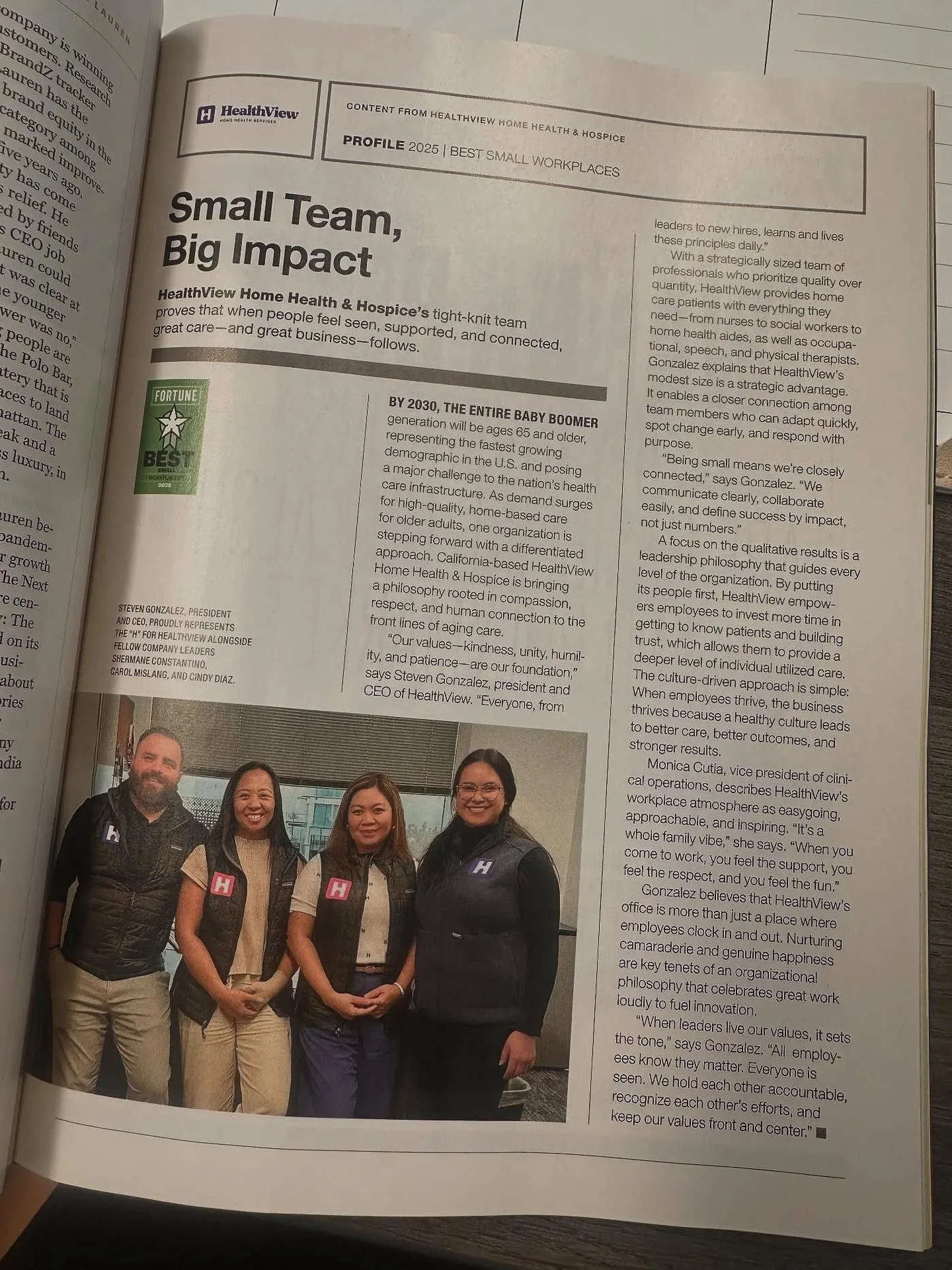
At HealthView we have been running the counter-experiment, mostly without knowing Patagonia had run it first. We are the 97th fastest-growing private company in America on this year’s Inc. 5000 list, which by Chouinard’s math should have wrecked us. Over the same stretch our team satisfaction score in the Great Place to Work survey went from 95 to 98 percent, and Fortune moved us from 23rd to 16th on its Best Small Workplaces list. I am not listing those numbers to take a bow. I am listing them because they are the only honest evidence I can offer that growth above the industry’s normal speed does not have to outrun the culture, and because third parties audited them, which is the only kind of culture claim I think anyone should accept, including from me.
There is a photo I keep coming back to. Last fall Fortune ran its Best Small Workplaces issue, and on our page there are four of us, Shermane Constantino, Carol Mislang, Cindy Diaz, and me, all in black Patagonia vests with the H on the chest. We chose Patagonia for our branded gear on purpose, because of how the company is run. Built on quality, not built on biggest. Here is the part I only noticed this month: that photo was taken a year before I ever read Chouinard’s book. The vests were an instinct about a company we respected, not a strategy from a manual. We were wearing the philosophy before I knew it had a book. That is either a coincidence or evidence that the same values pull companies in the same direction. Probably some of both, and I am comfortable not knowing the split.
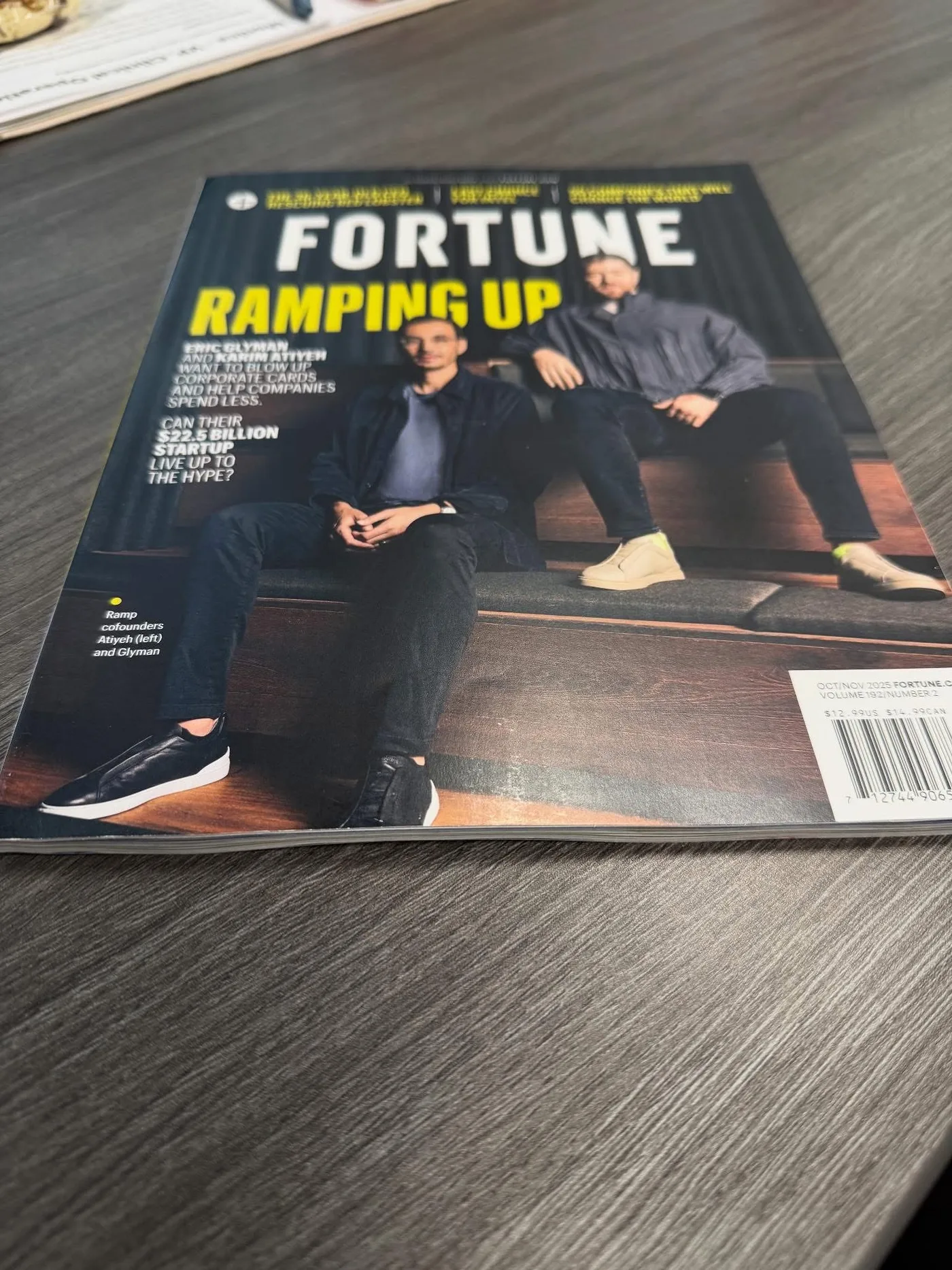
My October article even mapped our values to the water. Kindness steadies our balance. Unity means we paddle together. Humility is how we respect the ocean. Patience waits for the right wave. I liked those sentences when I wrote them, and I still believe them. But by this note’s own test, believing them is not enough. A value mapped to a metaphor is still a poster until it becomes a policy with a receipt, and I do not get to exempt my own company from the test I just ran on Patagonia. The audited numbers above are the receipts those four words have today. The work in front of me is making sure each one of them keeps costing us something.
The discipline underneath is not complicated, and it is all translation from the same principle: know your absorption rate and price it into the growth plan. Hire slower than the census says you could. Treat onboarding as culture transmission, not paperwork. Make every stated value a policy with a receipt, and if you cannot name what a value costs you, delete it from the wall before it embarrasses you. The industry data even agrees: the same benchmarking report found agencies that invest real hours in onboarding and ongoing training grew revenue by roughly $350,000 a year more than those that did not. The market pays for absorption. It just pays slowly, which is why almost nobody builds for it.
07The Prediction
The industry’s current bet is that technology, especially AI documentation, will fix the workforce problem. I think the tools are real and I think the bet is wrong, because it treats a culture problem as a software problem. Turnover in home-based care is not primarily a typing problem. It is an absorption problem, and you cannot install absorption. My October article had the image for this before I knew where to aim it: a workplace optimized for speed without meaning is a perfectly engineered board with no ocean beneath it. The industry is about to buy a lot of very fast boards.
If I am wrong and the number in the ledger below falls under 60, one of two things happened. Either the tools mattered more than I believe, or enough operators finally built for absorption. I would be glad to lose this one either way.
08The Ledger
Every field note that makes a prediction gets a dated line on the public ledger. Here’s this one.
What Would Change My Mind
Three things. First, credible longitudinal data showing AI documentation adoption driving turnover down in agencies that changed nothing else about culture, pay, or scheduling. That would mean the typing really was the problem. Second, evidence that Patagonia’s numbers are survivorship dressed up as method, meaning a population of companies that ran the same policies and died anyway. I looked and did not find that population, but absence of evidence is not proof. Third, HealthView’s own numbers breaking under continued growth. If our satisfaction score erodes as we scale, the absorption rate was real and I misjudged ours, and I will write that note too, because a ledger you only update when you win is a poster.
Chouinard spent fifty years proving that a company is what it pays for, not what it prints. He wrote the whole thing down in a book named after a policy, and I spent last October writing about surfing without ever asking what the policy would cost me. Now I have my fourth lesson. The waves in my industry are real people, showing up to a stranger’s door on the hardest day of that family’s life. What we can absorb, we keep. What we cannot, we lose at 75 percent a year.
I would rather grow at the speed of what we can keep.
READ NEXTNº 19 · The Permission MachineEveryone in healthcare says the words prior auth. Almost nobody can tell you what actually happens between a doctor’s order and the thing that never arrives. So I traced …No comment box here on purpose. The discussion for every field note lives on LinkedIn, in public, with names attached.
The next one ships when it's true. Leave an email and it finds you.
Unsubscribe anytimeReferences · 15 sources
1. Yvon Chouinard, Let My People Go Surfing: The Education of a Reluctant Businessman. Penguin, 2005; revised 2016. Flextime policy, blacksmith-era origins, the 1972 clean climbing catalog, and the Black Wednesday account.
2. Contemporaneous reporting on the 1991 crisis: flat sales, the bank clamping the credit line, inventory dumped below cost, 120 layoffs, about 20 percent of the workforce. Inc. Magazine, “Lost in Patagonia,” August 1992. inc.com
3. Ownership transfer structure: Patagonia Purpose Trust holding 2 percent voting stock, Holdfast Collective holding 98 percent nonvoting, roughly $100 million projected annual dividend. Patagonia Works press release, September 14, 2022. patagoniaworks.com
4. Company valuation of about $3 billion, per the New York Times. CNBC, September 15, 2022. cnbc.com
5. The 2011 Don’t Buy This Jacket ad and the roughly 30 percent sales increase in the nine months following. IMD case study. imd.org
6. Revenue of roughly $415 million in 2011 and $543 million in 2012, as reported across the published case literature on the campaign.
7. Patagonia’s roughly 4 percent corporate turnover against a retail and consumer sector average above 13 percent. Inc.com, Scott Mautz. The 900 applications per opening figure is reported in HR Executive’s coverage of the company. inc.com
8. Five-year stretches of 100 percent of mothers returning from leave, program-parent turnover 25 percent below the general population, and replacement costs of 35 to 125 percent of salary. Patagonia Stories, Rose Marcario. patagonia.com
9. The 1983 childcare origin and roughly 91 percent of program cost recouped. U.S. Chamber of Commerce Foundation. uschamberfoundation.org
10. Median caregiver turnover of 79.2 percent in 2023 improving to about 75 percent, and the roughly $350,000 revenue lift for agencies with structured onboarding and training. Activated Insights, 16th Annual Benchmarking Report, 2025, and the 2024 edition. prnewswire.com
11. Hospice RN turnover of 25.53 percent in 2023, per the Hospital & Healthcare Compensation Service Hospice Salary & Benefits Report with NAHC, 704 hospices surveyed, as covered by Hospice News; hospital RN turnover of 18.4 percent in 2023, per the 2024 NSI National Health Care Retention & RN Staffing Report.
12. HealthView receipts: Fortune Best Small Workplaces 2026, Nº 16, up from Nº 23; Great Place to Work team satisfaction of 98 percent, up from 95; Inc. 5000 2026, Nº 97. Third-party audited and published rankings.
13. Steven Gonzalez, “3 Leadership Lessons From Surfing,” Inc.com, October 28, 2025. inc.com
14. Chouinard on Management by Absence: “I take off for weeks at a time and never call in.” Quoted in Schermerhorn, Management, 12th edition, Wiley. The 1964 catalog note and the MBA description in his own words appear in the Trust for Public Land’s interview; Kris McDivitt’s 1979 appointment per David Gelles’s Patagonia coverage.
15. Fortune, Best Small Workplaces issue, October/November 2025 print edition, HealthView Home Health & Hospice profile, “Small Team, Big Impact.”