

Listen to this field note21 min
Read in Steven’s own voice, made with AI.
A note before we start. This one is personal, and it’s long. It’s about two books, Huberman’s Protocols and Jay Shetty’s Think Like a Monk. It’s about what I took from each of them to run a home health and hospice company, and the two conversations I had with the men who wrote them. The hospice numbers are sourced on the page. The lessons are mine, and some of them I’m still testing.
01The voices on my walks
In Working Backwards I wrote that I never met Jobs or Buffett, and that the voices that live in my soul belong to the patients who died in our care and their families. That’s still true. But there’s another set of voices in my ears every day.
I walk every day. On my walks it’s usually one of three shows. David Senra’s Founders, Jay’s On Purpose, or Huberman Lab. I’ve now met two of the three people I listen to every week.
Founders is history, one founder at a time, and history and learning are what kept me going on the days I wanted to quit. Read enough of those stories and you see that every path to success runs through extreme pain. Entrepreneurs are built different that way. I’m drawn to stories of extreme struggle, people working through every obstacle and finding the positive in it. Maybe I’m a sucker for the underdog because I am one. I get so energized learning from other people’s stories.
So when I got the chance to talk to two of them, I took it. One of those conversations went nowhere near where I planned.
And now I have a podcast of my own. This one. On top of running HealthView and building CultureAI.
02The Delta lounge
I figured if I ever got real time with Huberman, I’d ask about sleep. Or focus. Or how to keep a leadership team sharp when the work is heavy. He’s a Stanford neuroscientist with one of the biggest health podcasts in the world.
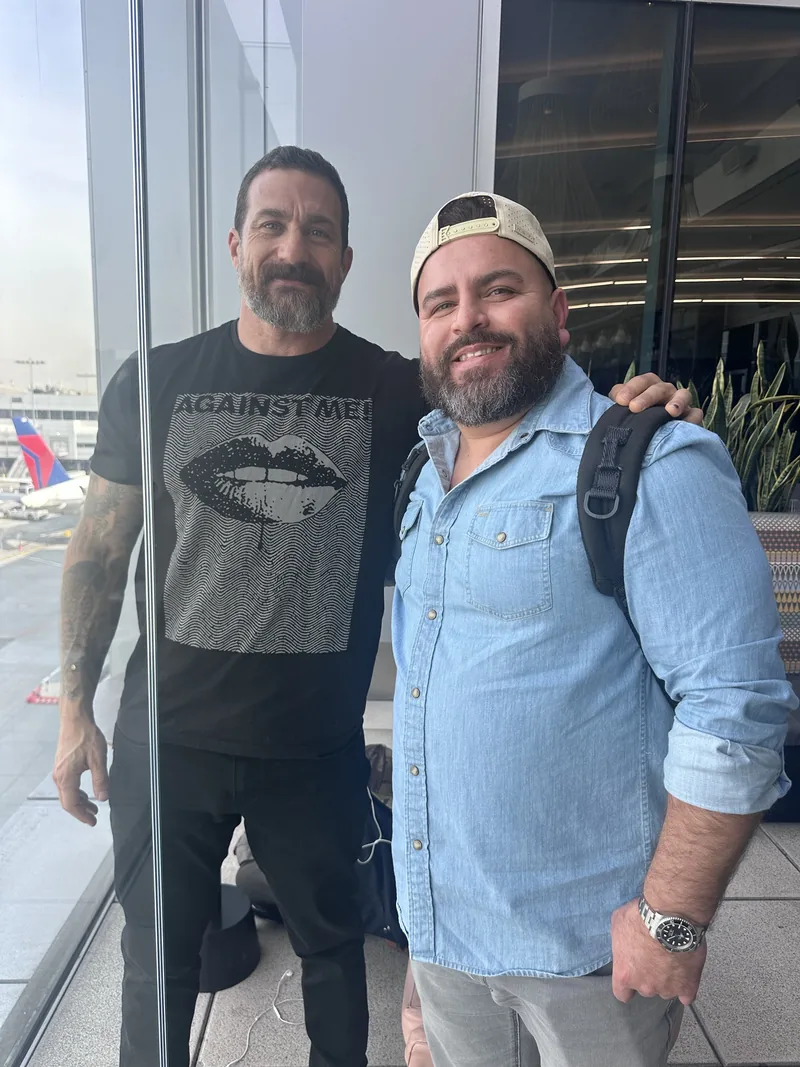
We talked about our bulldogs.

Spartacus was dying at the time. Cancer, in more than one organ. Huberman had already been through it. If you listen to his show you know Costello, the big white bulldog who sat in on his episodes. Costello died in the summer of 2023. That June, Huberman posted a picture from 2013 of himself holding Costello up like a sack of flour. Walking the bulldog, he called it. Same shirt, different day.
I have a picture like that too. It’s from my 30th birthday, in 2013, the same year as his. I’m standing behind the cake holding Spartacus as a puppy, small enough to fit in one arm. There’s another one from years later. Same move, me holding him up to the candles, and he’s not small anymore.
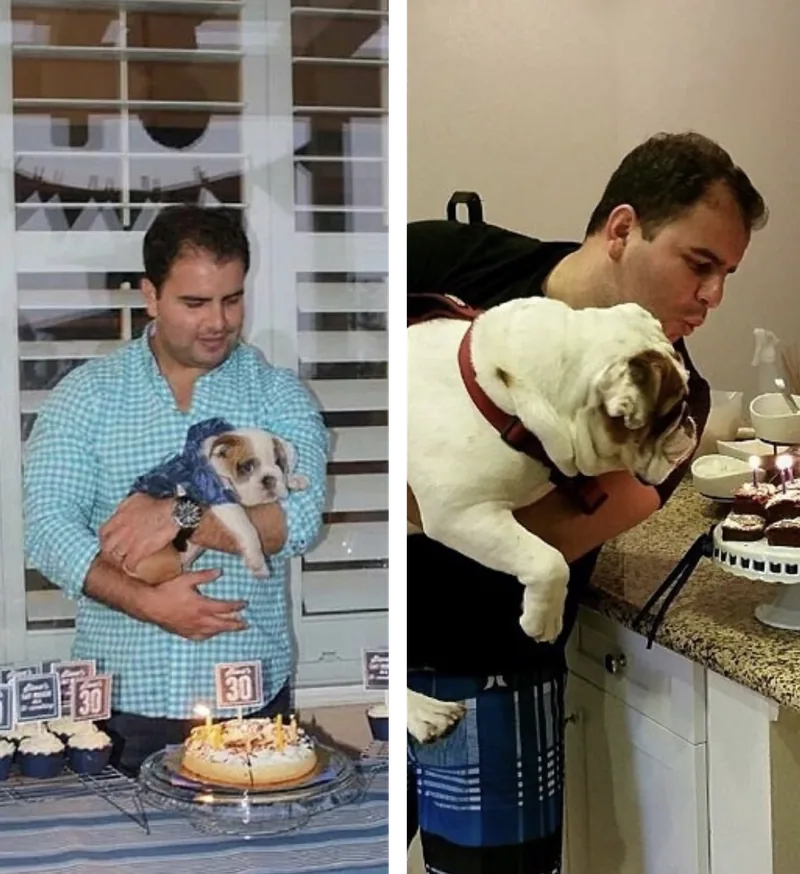
So that’s what two guys who had just met did with most of an hour. We talked about what it’s like to watch your dog get old, and what it’s like after.
I didn’t expect that to be the part I’d remember. It is.
In Working Backwards I wrote that nobody at the end of life talks about their title. What people hold onto is small and specific. People, by name. A porch. A particular meal. And here was the guy who wrote an operating manual for the human body, and what he wanted to spend the time on was a bulldog who had already died. That’s the inventory at the end, showing up early, in the middle of a busy life.
03By the couch
Spartacus was with me through all of it. From that birthday through PokitDok, the hospice years, and the day I became CEO of HealthView. Maybe that’s why I was so attached to him. He followed me through the whole stretch of figuring out the world of business.
When my grandma died, I was sad and heartbroken. This was different. Your dog is with you every day. He’s built into your habits. When he’s gone, the habits are still there, and that’s the part that’s hard to get past.
I still cry about him sometimes. There’s a lifelike urn of him in our living room, by the couch, where his favorite spot was. Jay has a chapter called location has energy, time has memory. That’s the spot by the couch.
04What a book about the body taught me about running a company
Protocols came out on September 15. Seven sections: sleep, exercise, stress, nutrition, light, focus and learning, and personal growth. In every one of them, the free stuff comes first. Getting outside in the morning. Moving. Breathing. The supplements and the gadgets come a lot later. He’s very clear that behavior comes before products.
Read it as an operator and it works like a management book that happens to be about cells.
Start with the order. That book is built the way we built HealthView. Culture first, AI second. Our clinical team is our executive leadership, and our nurses sit in the finance and technology decisions, because they’re the ones who have to live with whatever we buy. The rule I run on is simple. Question the requirement, delete what you can, simplify what’s left, speed it up, and only then automate. Most companies in my industry buy the software first and hope it fixes the team. That’s taking a sleep supplement while you’re on your phone at midnight. You fix the foundation, and the tools finally have something to work on.
Then there’s stress. Huberman says it has two dials. The fast dial is calming yourself down right now. His tool for that is the physiological sigh, two breaths in through the nose and one long breath out. The slow dial is raising how much stress you can take before you break. You don’t turn that one in the moment. You build it over months.
A company has both dials. This year was hell for us. We’re a compliant provider in LA County, and we got swept up in the federal crackdown on home care fraud anyway. A hospice audit held our payments while we proved eligibility. County referrals went quiet. Banks got nervous. The fast dial was staying calm in front of my team every day. The slow dial was the cash reserves we built years before anyone knew we’d need them. That’s what got us through. You can’t build a stress threshold in the middle of the stress. You build it before, when nobody’s asking you to.
He also tells you to be a systematic observer of yourself. Change one thing at a time and write down what happens, or you’ll never know what worked. That’s how I want to run a healthcare company. One change, a scoreboard everybody can see, and an honest look at what moved. Our Great Place to Work score went from 95 to 98 percent this year. That number tells me when something we changed actually reached the people doing the work.
He walks through how the brain learns, too. Get alert, get focused, make mistakes, feel the frustration, rest, and sleep on it. The errors are the signal that tells the brain to change. Most of our management team are nurses who still see patients. Nobody hired them to be business people. They learned it on the job, and they made mistakes doing it, because that’s how learning works. We’re writing our own playbook for post-acute care, so some things we try won’t work. That’s iteration. I’d rather have a team that’s allowed to be wrong out loud than one that’s confident and wrong.
There’s a sea squirt in the exercise section. It swims around until it finds a place to settle. Once it stops moving, it digests its own brain, because it doesn’t need it anymore. It reminds me of companies. The ones that stop moving, that sell every three to five years and turn over their people every year, lose the part that thinks. We’re not selling HealthView. I want the people who are here in ten years to still be learning.
And then, at the very end of the book, there’s grief. He writes about grief as yearning, wanting someone who isn’t there anymore. I read that section knowing what Spartacus meant to me, and knowing what our hospice teams sit with every week. Medicare requires a hospice to keep supporting a family through grief for up to a year after their person dies. Grief is part of the plan of care. It’s in the regulations. Most companies outside hospice act like grief is something you handle on your own time.
05No. 97
I met Jay at the Inc. 5000 conference. We both made the list this year. He made it with his company, Juni. HealthView came in at No. 97.
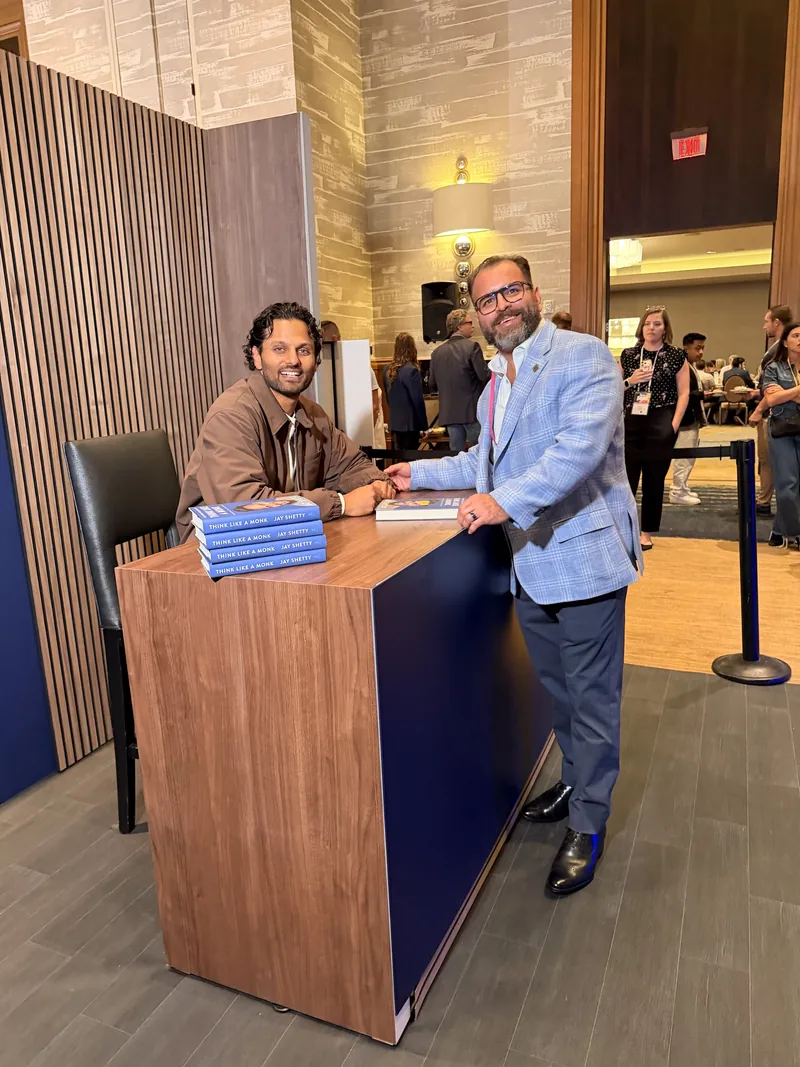
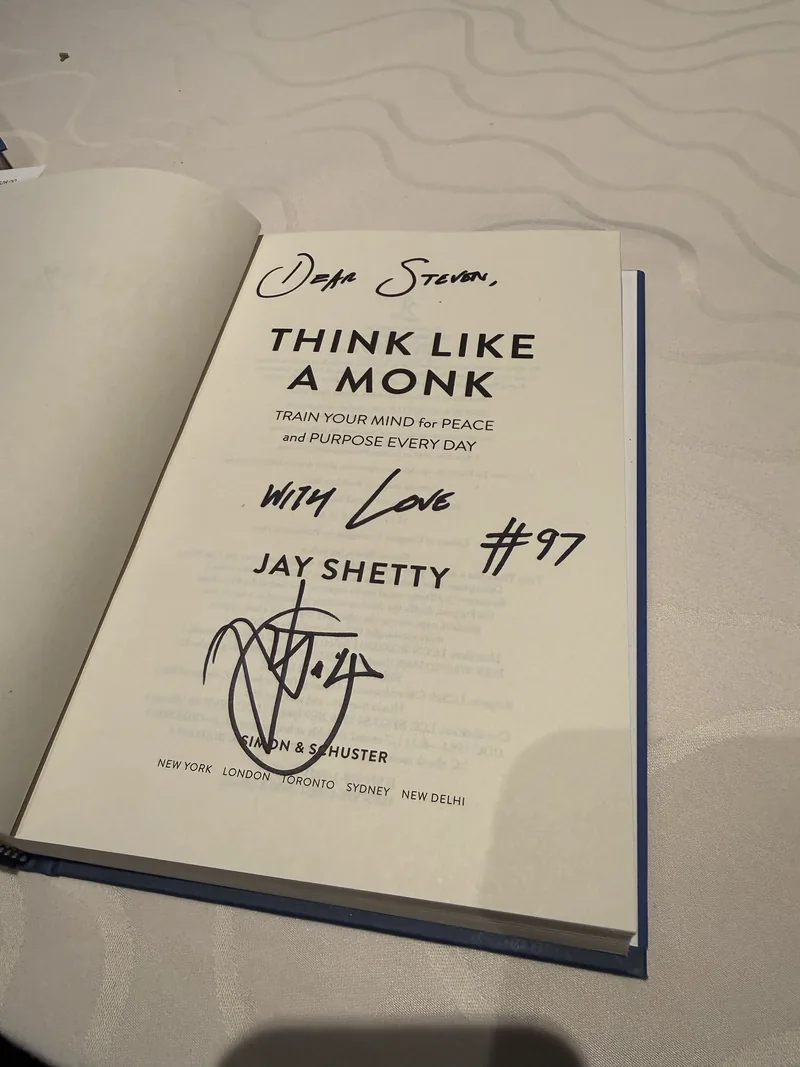
I told him I work in hospice, and that his podcast has been worth a lot to me, because it’s helped me live with purpose now and not someday. When you work with people at the end of life, you realize how important that is, and how much being present matters. He signed my copy of Think Like a Monk. Dear Steven, with love. Under that he wrote No. 97.
Here’s why now and not someday hits so hard in my world. About half of Americans on Medicare who die now use hospice. Half of them are on hospice for eighteen days or less. A quarter get five days or less. Someday is a luxury most of our families found out they didn’t have.
06What a monk taught me about running a company
Jay spent three years as a monk before he came back out and started making videos. The book has three parts: let go, grow, give. And the chapter titles are strange in a good way. Negativity: the evil king goes hungry. Fear: welcome to hotel earth. Purpose: the nature of the scorpion. Service: plant trees under whose shade you do not plan to sit. I’m going to walk through the ones I actually use.
The first chapter is about identity. Most of us live as the person we think other people think we are. That’s a lot of layers between you and yourself. HealthView got told a long list of things wouldn’t work. No sales team. Nurse leaders running both home health and hospice. Nurses who work both services. Treating culture and taking care of people like something we could afford. If we’d run the company as the one other people expected, none of that would exist.
Then there’s negativity. Jay’s method is spot it, stop it, swap it. Notice the thought, stop it, and swap it for something better. When I read that I laughed a little, because I’ve been running a version of it most of my adult life. Be cool, be positive started as a mental exercise to get myself through hard stuff. Be cool means stay calm. Be positive means find the positive in what’s in front of you. There’s a tweet of mine from 2009 that signs off with it, smiley face and all.
This year was the real test of it. The positive I had to go find was this. As other agencies closed, more clinicians wanted to work with us than ever. So we made the interviews longer, added ride-alongs, and sent people who weren’t a fit to our neighbors. That’s the swap.
The fear chapter is called welcome to hotel earth. We’re all guests here. Everything we have, we’re checking out of eventually. For most people that’s a metaphor. In hospice it’s the job. My teams sit with families at the very end every week. It makes you hold things more loosely, titles and money especially, and it makes you hold people tighter.
Jay also says everything we do comes from one of four places: fear, desire, duty, or love. Fear and desire burn out. Duty and love last. It works on business decisions too. A lot of my industry runs on desire. Buy it, grow it fast, sell it in five years. People can feel that. They know when they’re inventory in somebody’s exit. I’m not selling HealthView, and the people who work here know it. I don’t quit on you and you don’t quit on me. That’s duty and love. It’s slower, and it lasts.
There’s an old story in the purpose chapter. A monk keeps pulling a scorpion out of the water, and it keeps stinging him. Somebody asks why he keeps doing it. He says it’s the scorpion’s nature to sting, and it’s his nature to save. That’s a nurse. Jay writes about finding the place where what you love, what you’re good at, and what the world needs all meet. I see nurses as the real engineers of my industry. They walk into the hardest room in somebody’s house and they keep coming back. So at HealthView, the clinical products come from the people delivering the care.
The ego chapter is the one that hit hardest. Jay’s practice is to remember the bad you’ve done to others and the good others have done for you, and to forget the good you’ve done and the bad others have done to you. Ego is the worst thing a leader can bring into a room. Some of my best managers never wanted to be managers. They were called to it, and they carry it better than the people who chased it. Humility is one of the four words in the HealthView Way, next to kindness, unity and patience. I try to say what I got wrong before anybody has to tell me.
The give section covers gratitude, relationships and service. The way I’d put relationships for a company is this. Trust is the greatest economic force in the world. With trust you need fewer rules. Without it you need more. Fewer rules means speed. My competitors turn over a big share of their people every year and sell every few years, so the trust never gets built. That’s the one thing they can’t copy.
07Plant trees
The last chapter is called plant trees under whose shade you do not plan to sit. That’s the reason I’m in this.
My grandma, who was very special to me, had a very unspecial death in a hospital. That’s when I knew the end of life had to change. The first modern hospice opened in London in 1967, the same year HealthView was founded. Medicare started paying for hospice in 1983, the year I was born. That, and the path my life took to get to hospice, feels like a calling, not a coincidence.
The end of life is the part of healthcare that has changed the least since then. In 2017, home passed the hospital as the most common place Americans die, for the first time in a long time. People want to be home. The system still isn’t built for it.
I’m planting for that. And I’ve said it before: if what we build helps people live healthier for longer, it might shrink the demand for my own business. That’s okay.
I’m also planting for my two daughters. I want them to see a world where you can build things. Where you don’t have to take the world as it is, or be who it wants you to be. It’s a malleable place, if you have the courage to build something. And it starts with being consistent, and being excited about the hard things. I want them to live a life of purpose and generosity. And I want them to see a man who is steady and consistent, and who gives them the safety to be whoever they want to be.
08The strongest objection
There’s an easy eye roll to all of this. A CEO reads two wellness books, meets two famous podcasters, and writes about it. Meanwhile the nurse on her sixth visit of the day doesn’t have a morning routine. She has a schedule, a car, and a patient waiting.
That’s fair. The tools in Protocols are free, but the time isn’t, and in home health the schedule belongs to the employer. If I’m going to talk about foundations, the hours are on me. That’s the part I’m still working out, and I’ll write about it when I have something real to show.
09The last room
Jay’s book starts with identity. I’m building mine backwards, from the last room. I think about my obituary, and a full room at the end, and the man I want that room to have known. That’s why I’m up early every day and on all the time. I know I’m on a clock.
I believe in God and I believe in heaven. But I want to make an impact while I’m here. My hope is to build a company that lasts, fueled by culture, and along the way help people discover their human potential, in the service of others. I know that one day, that’s how I’ll discover mine.
When it’s hard, I go back to Romans 5. “We also glory in our sufferings, because we know that suffering produces perseverance; perseverance, character; and character, hope.” My family has a saying for that. We endure.
10Presence
I wrote a piece for Inc. that said certainty is overrated and presence is underrated. Your team doesn’t need you to have every answer. They need to know you’re actually in the room.
Read closely, both books are about showing up, the body in Huberman’s and the mind in Jay’s. And both conversations ended up being about the same thing. Huberman and I were really talking about the time we had with our dogs. Jay and I were talking about not waiting for someday.
When I talked to Huberman I didn’t have a podcast. Now I do, and those two conversations are part of why.
In college I was the business writer for The New Englander, the student paper at New England College, a small private school in New Hampshire. I loved it. Researching a company, figuring out how it really worked, then writing it up. I never stopped the learning part. I just stopped writing it down for a while, and I’m happy to be writing again.
So this is the journal. I’m going to change how the end of life is done in this country. I’m working backwards toward it, and I’m writing down what I see from this chair as it happens, including the parts that don’t work. I want to get people talking about the end of life. Culture is what’s fueling it.
Spartacus died almost two years ago. I still think about that hour in the Delta lounge. And I still have the picture from my 30th.

In January we bring home a Goldendoodle puppy named Bodie. Nobody replaces Spartacus. But there’s going to be a puppy in the house again.
The conversation
No comment box here on purpose. The discussion for every field note lives on LinkedIn, in public, with names attached.
ReceiptsSourced factsHis own words
References · 8 sources
1. Andrew D. Huberman, Protocols: An Operating Manual for the Human Body (2026). hubermanlab.com
2. Jay Shetty, Think Like a Monk (Simon & Schuster, 2020).
3. Jay Shetty, How motivations reveal your true intentions. jayshetty.me
4. JUNI on the 2026 Inc. 5000. prweb.com
5. MedPAC, Report to the Congress, March 2025, Ch. 9: Hospice services (51.7% of Medicare decedents used hospice in 2023; median length of stay 18 days; 25th percentile 5 days). medpac.gov
6. Cross and Warraich, NEJM 2019: home deaths 30.0% versus hospital 29.8% in 2017. hospicenews.com
7. NHPCO, History of hospice (St. Christopher’s 1967; the Medicare hospice benefit, 1982 law and 1983 regulations). nhpco.org
8. 42 CFR 418.64(d), bereavement services for up to one year after death. ecfr.gov